How AI-supported communications are transforming community housing operations by turning tenant conversations into operational intelligence.
Community Housing Providers operate at the intersection of housing, vulnerability, and trust.
Every day, frontline teams handle conversations that involve distress, financial pressure, maintenance frustration, safety concerns, and at times, personal crisis. These calls are not transactions — they are moments of human reliance.
At the same time, Boards and executives are expected to demonstrate governance maturity, defensible tenant satisfaction outcomes, and compliance strength under NRSCH and CHRIS reporting frameworks.
Historically, human complexity and regulatory structure have not always aligned neatly, but that gap is beginning to close.
Emerging AI-supported capabilities within global cloud communication platforms are now converting tenant conversations into structured, searchable, governance-ready data — without losing sight of the human context behind them.
This is not about replacing people.
It is about supporting them and the tenants they serve.
The Invisible Administrative Load on Frontline Teams
In many housing environments, frontline officers spend significant time after each call manually documenting what occurred — the essential wrap-up notes.
Across one recent operational review, this equated to approximately 26 hours per month per officer spent on post-call wrap-up and note preparation, or roughly 18–20% of their time.
Across a team, that can equate to nearly a week of administrative effort every month — time not spent resolving issues, supporting tenants, or proactively engaging vulnerable households.
The financial recovery is material.
But the human recovery is more important.
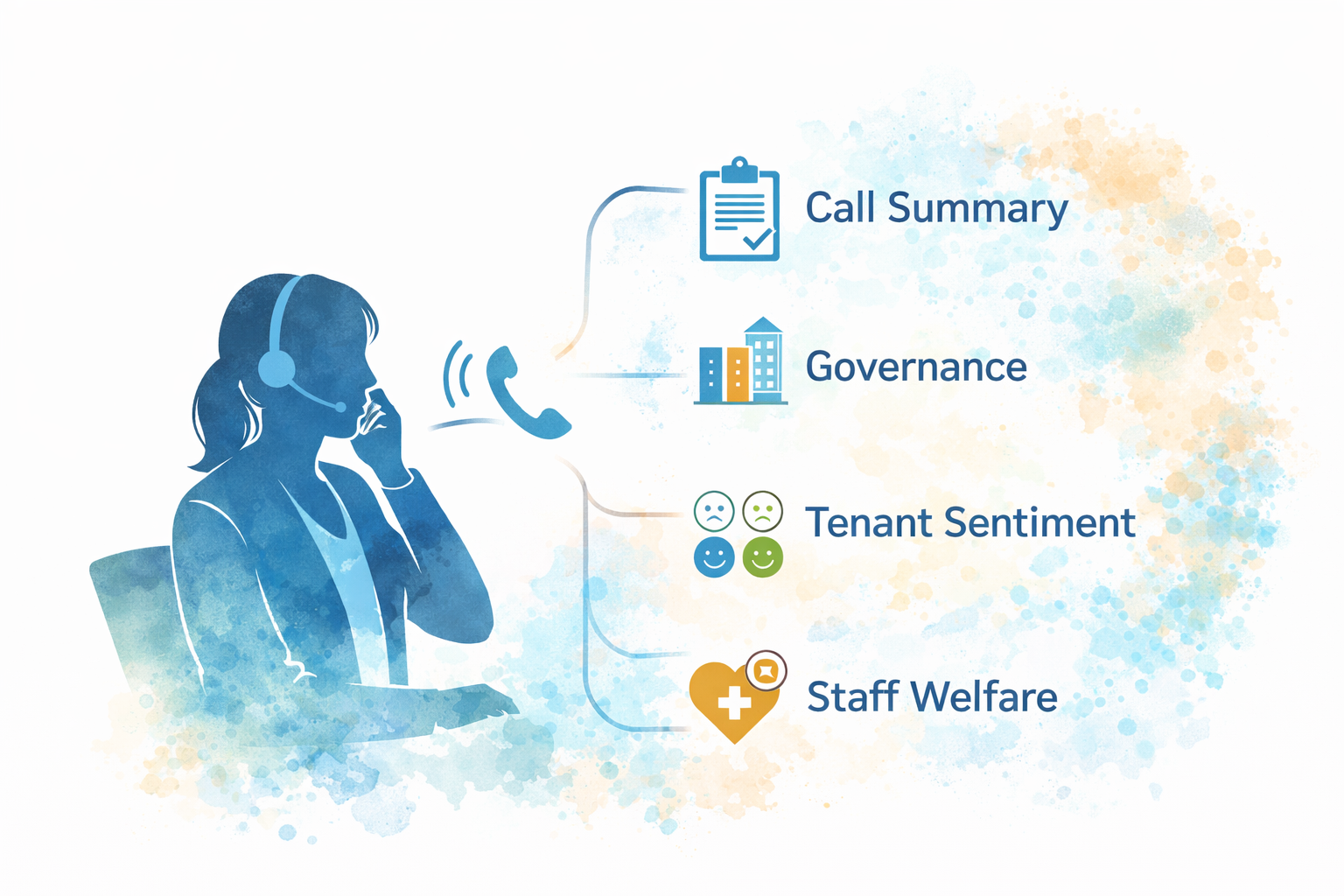
Reducing manual documentation burden gives customer service officers space to focus on empathy, clarity, and resolution — while AI-supported communication platforms transcribe and summarise the call and insert the interaction directly into the tenant record.
Improving Documentation Without Adding Pressure
Good governance relies on good records. But in practice, documentation quality often depends on how busy someone was that day.
AI-supported transcription and structured summarisation now allow:
Automatic call transcription
Consistent, structured summaries
Direct insertion into CRM case files
Standardised documentation across teams
This reduces variability and strengthens evidentiary quality for complaints, tribunal matters, and compliance reviews.
More importantly, it protects both tenants and staff.
Clear records support fairness. They ensure that decisions are traceable, defensible, and grounded in what was actually said — not what was remembered later.
Listening at Scale: Early Warning with Empathy
Under CHRIS and NRSCH, tenant satisfaction must be measured, participation rates monitored, and results contextualised.
Traditionally this occurs once or twice a year, often requiring significant effort to obtain responses.
But tenants communicate their experience every day — through tone, language, and emotion.
AI-supported sentiment analysis and theme tracking now allow providers to identify:
Emerging dissatisfaction
Repeated frustration around maintenance
Escalation language
Signals of distress or vulnerability
Patterns of aggressive or abusive interactions
This is not about surveillance. It is about awareness.
Early visibility allows earlier support — whether directed to a tenant experiencing difficulty or to a frontline staff member exposed to repeated high-stress interactions.
In this way, governance and compassion begin to align.
From Annual Survey to Continuous Care
CHRIS requires quantified survey reporting and measured participation. But regulators also assess governance maturity and responsiveness. A staged maturity approach is beginning to emerge.
Stage 1 — Visibility
Continuous transcription and sentiment tracking create real-time awareness of emerging service themes.
This reduces the risk of end-of-year survey surprises and enables earlier intervention.
Stage 2 — Engagement
Post-call micro-surveys and maintenance-triggered satisfaction prompts improve participation rates and give tenants a simple, immediate voice.
When designed carefully, these tools reinforce dignity and accessibility rather than create friction.
Stage 3 — Governance Integration
Sentiment dashboards, trend analysis, and documented service recovery processes allow Boards to see not only outcomes — but oversight in action.
Tenant experience becomes part of governance infrastructure.
Supporting Staff Wellbeing and WHS Oversight
Community housing staff routinely absorb emotionally charged interactions.
Often, the impact on wellbeing only becomes visible after burnout, absenteeism, or escalation.
AI-supported tracking can highlight patterns of repeated exposure to aggression or distress.
This allows:
Proactive workload balancing
Earlier managerial support
Better WHS oversight
Reduced cumulative stress
When implemented responsibly, this is not a performance tool.
It is a duty-of-care enhancement.
Strengthening Financial and Operational Stability
Structured interaction data also provides clearer insight into:
Rent hardship patterns
Repeat maintenance drivers
Contractor dissatisfaction
Communication gaps contributing to arrears
When conversations become structured data, operational blind spots reduce.
This strengthens the integrity of CHRIS submissions and annual compliance returns by grounding them in documented evidence rather than anecdotal explanation.
It supports a narrative of oversight, not reaction.
Technology as Infrastructure, Not Experiment
Importantly, these capabilities sit within existing telephony and call-recording frameworks. They do not require radical process overhaul.
The risk profile is typically centred on adoption and change management — manageable through staged rollout and clear internal guidelines.
This is not experimental AI and a human-in-the-loop process to vet the call summaries and insights can be easily built into an AI policy for the organisation as per new Australian privacy legislation.
It is infrastructure maturing to reflect the realities of modern community housing.
How Donnabrook Helps
At Donnabrook, we work with Community Housing Providers to help them understand how emerging communication technologies can support governance, operational visibility, and tenant service outcomes.
This typically begins with benchmarking the health of an organisation’s current communications environment — including telephony, call recording, and interaction management.
From there, we help organisations assess how modern cloud-based communication platforms can support better documentation, stronger governance insight, and improved operational efficiency.
Our role is to help organisations transition responsibly and adopt new capabilities in a way that strengthens both tenant trust and frontline staff support.
In Summary
For decades, phone calls in housing were transient.
Today, they can become:
Structured case records
Sentiment indicators
Escalation alerts
Maintenance intelligence
Board-ready oversight artefacts
But beneath the data sits something more important:
A tenant trying to resolve a problem.
A housing officer trying to help.
A Board trying to govern responsibly.
The real shift is not technological. It is evolution.
From reactive reporting to proactive care. From fragmented notes to structured fairness. From annual measurement to continuous listening.
For Community Housing Providers, the question is no longer whether this capability exists.