

Community housing providers work to an effectively fixed maintenance budget. Seeing the problem during the repair call, before anyone is sent, takes waste out of how repairs are diagnosed and delivered. The same budget then completes more repairs, with fewer appointments for tenants.
The gap the current measures miss
With a fixed maintenance budget, every wasted visit or unnecessary urgent call-out is a repair the budget can’t fund. On the published figures, the sector looks strong. Look closer and the numbers don’t line up:
- 91.5% and 84.9% of urgent and non-urgent repairs were completed on time by large community housing providers in 2024–25.
- 77.8% of tenants were satisfied with maintenance, despite 91.5% of urgent repairs being on time.
- 320,127 repair requests were logged by large community housing providers in 2024–25.
- Not tracked: visits per repair, first-time fix, and whether the priority was right.
Sources: NRSCH Sector Non-Financial Performance Report 2024–25; NRSCH Performance Metrics, December 2025.
The timeliness figures count jobs closed within the window for the priority they were given. What they leave out is where the money goes. Was the job given the correct priority? How many visits did it take? And why did it need more than one?
Where the cost is lost
| Where the cost is lost | What it costs |
|---|---|
| Wrong priority: too high | Urgent premiums and after-hours rates, and urgent capacity taken from genuine emergencies |
| Wrong priority: too low | Risk to the tenant’s safety, further damage to the home and a breached urgent response time |
| Wrong trade or missing parts | A second visit, a second appointment and a longer wait for the tenant |
There is no published baseline for whether urgent jobs were genuinely urgent, how many visits each repair took, or why repeat visits happened. Without these, no provider can show where its reactive cost is lost, or prove that a change has reduced it.
Why priority matters so much in housing
Priority is set once, at intake, and everything follows from it. It decides the response window, the rate paid and which timeliness measure the job counts towards. Yet it is usually set from a phone description alone.
We suggest providers add five measures to what they already report:
| Add this measure | What it reveals |
|---|---|
| Priority accuracy | Urgent jobs that could safely have been routine, and routine jobs that should have been urgent |
| Visits per completed repair | How many trips each repair actually takes |
| First-time fix rate | The share fixed on the first visit (cross-industry median 75%: Aquant 2025, via VSight) |
| Repeat visits and causes | Which jobs needed a second visit, and why: trade, parts, access or diagnosis |
| No-access rate | Visits where the trade could not get in, usually held only by contractors |
See the problem before you send
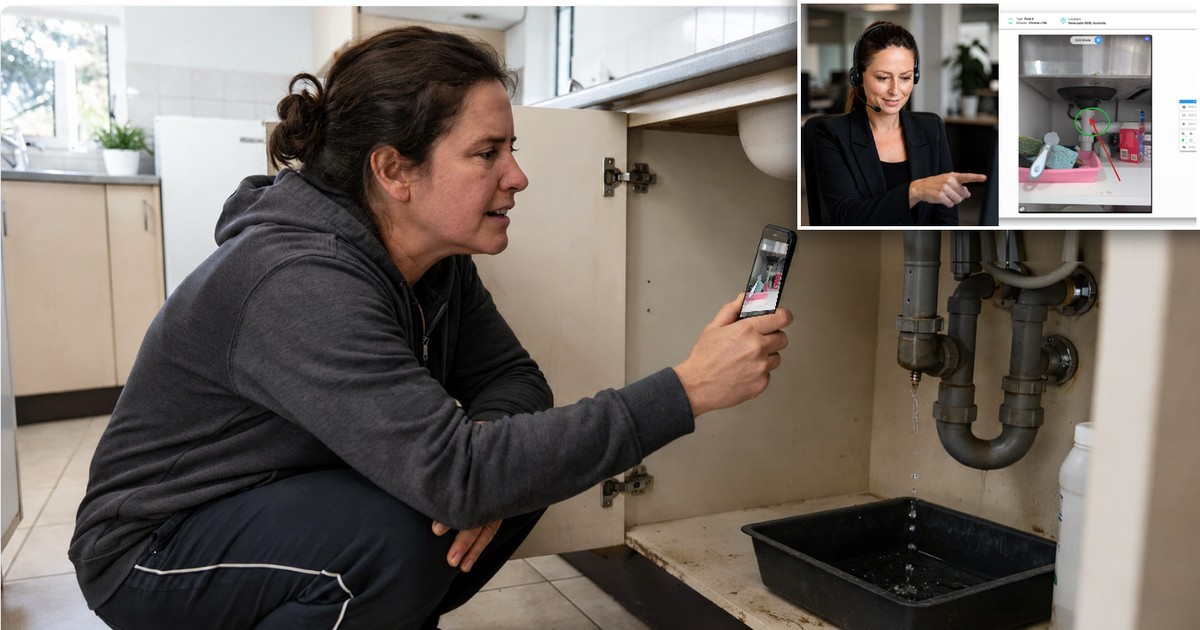
Remote visual guidance lets a customer service officer capture photos during the call, so the person with trade knowledge can see the fault before deciding what happens next. Seeing the fault before the work order is raised improves four decisions:
- Who to send: the right trade, first time.
- What to bring: the parts and materials for the job.
- Priority: urgent or routine, set on what the officer can see.
- Call-backs: photos are taken on the first call, so there’s no ringing the tenant back.
The intake officer sends an SMS link and the tenant shows the fault in a live visual session, with no app needed. On site, a technician can call a specialist who guides the repair live. Donnabrook provides this as Donnabrook Visual Assistance (DVA), powered by TechSee Live.
Every session also leaves a time-stamped record at the address and asset, so recurring faults feed condition data and planned renewal cases.
Estimating the value for your organisation
Three costs created by unclear fault reports can be sized from a provider’s own data, before any trial:
| Cost | How it is calculated |
|---|---|
| Second visits | Work orders × share needing a second visit for the same issue × cost of a field visit |
| Wrong priority | Work orders × share raised as urgent that could have been routine × the urgent premium |
| Call-backs to tenants | Work orders × share needing a call-back × minutes per call-back ÷ 60 × hourly staff rate |
A worked example from a Tier 1 provider
We are working with a Tier 1 community housing provider that has 42,000 reactive work orders a year and a $200 visit cost. We conservatively assumed:
- 5% of repairs need a second visit
- 10% are raised as urgent when routine would do (a $100 premium)
- 5% need a 12-minute call-back by a customer service officer for more detail
That comes to about $420,000 in second visits, $420,000 in avoidable urgent premiums and $18,480 of call-back time: $858,480 a year, or about $20 per work order. That is enough to fund about 4,300 more visits.
If only a quarter of tenants agree to photos being taken during the call (our conservative assumption), up to about $214,620 is addressable, or about 1,070 visits. So far in the trial, every tenant offered a session has accepted. At that rate, the full $858,480 is addressable.
Where contractors are paid per attendance, the saving is cash. With in-house trades, it means more repairs completed. Under fixed-price contracts, it’s a gain to capture at re-tender.
These figures are estimates based on stated assumptions, not measured results. Your own work order data will give a more accurate picture.
Will tenants take part?
Providers often assume social housing tenants won’t join a live visual session. Early experience suggests the way it is offered matters more than technical skill.
In an early trial at a Tier 1 community housing provider, one customer service officer ran 19 sessions in 30 days, including 14 live visual sessions and 28 images. She reported no outright refusals. Tenants with limited digital skills still tried, some with a neighbour’s help. A few couldn’t connect and emailed photos instead.
“It’s all about the language that you use with them.”
Customer Service Officer, Tier 1 community housing provider, after using it in the trial
What works:
- Offer the easy option: “I’m going to send you a link. You just need to click on it and it’ll allow me to take some photos.”
- Help now: if they can’t send photos by email, “well, we can do it now, if you want”.
- Don’t raise a risk that isn’t there: the session only streams the camera view.
The evidence so far
A vendor-reported 2019 TechSee analysis across more than 70 organisations outside housing found 19% fewer technician dispatches and 22% higher first contact resolution. In the UK, LiveWest (40,000+ homes, 1,000+ repair calls a day) uses TechSee daily to triage leaks, identify parts before a visit and guide simple fixes remotely. 99% of its agents say it helps them resolve issues without sending an engineer.
We found no published results from Australian social or community housing providers. So start with a quick trial and measure as you go.
Making it stick
The gains come from building it into the call, contracts and data, then proving the value through a quick trial and routine use.
- Process: set rules for offering a session, including any job about to be raised as urgent where it is safe to check first.
- Contracts: under per-visit payment, an avoided visit is lost contractor revenue. Agree incentives for correct priority and first-time fix before scaling.
- Data: record session outcomes and images on the work order and asset record.
- Tenants: keep it optional, with a phone-only path, interpreter support and explicit consent each time.
Measure from day one: sessions offered and accepted, call-backs avoided, priority and trade changes, repeat visits and technical inspections avoided.
Read the full white paper
This briefing summarises our white paper, The Missed Step in Community Housing Repairs: Getting the Photos During the Call, written by Donnabrook in partnership with Structured Creative. The full paper covers the case in more depth, including a practical path from trial to routine use.
The button opens a pre-filled email in your mail app. If it doesn’t open, email us at info@donnabrook.com with the subject “White paper request” and we’ll send it through.
About the authors
Andrew Olsen, Donnabrook. Newcastle-based, with 25+ years in enterprise technology. Andrew established Donnabrook five years ago, providing advisory services on communication technology and remote visual guidance in Australia.
Danny Bearzatto, Structured Creative. 20+ years in strategy and operations, specialising in infrastructure and field services, including as a Director in Deloitte’s Strategy and Operations practice. Structured Creative is a Melbourne-based field services consultancy.
Better insight. Better decisions. Better outcomes.